
New Zealand
 NZ is big on tourism and tourist facilities, mostly of excellent quality.
This Photo shows a sheep shearing demonstration at a tourist farm called the Agradome. Thousands of tourists, especially Asians, flock to this facility
daily.
NZ is big on tourism and tourist facilities, mostly of excellent quality.
This Photo shows a sheep shearing demonstration at a tourist farm called the Agradome. Thousands of tourists, especially Asians, flock to this facility
daily.
 At Arthur's Pass, we encountered these native parrots, called keas. They have no fear of humans and are most destructive! They have been
known to trash camp sites, cars and motorcycles by pulling apart anything loose or soft.
At Arthur's Pass, we encountered these native parrots, called keas. They have no fear of humans and are most destructive! They have been
known to trash camp sites, cars and motorcycles by pulling apart anything loose or soft.
 The centre of South Island is divided by a mountain range. This viaduct is at Arthur's Pass, on the highway between Greymouth and Christchurch. This is a
scenic drive through multiple climactic zones; it only takes a day.
The centre of South Island is divided by a mountain range. This viaduct is at Arthur's Pass, on the highway between Greymouth and Christchurch. This is a
scenic drive through multiple climactic zones; it only takes a day.
 Being a relatively new country, by European measures, there is not much old and interesting architecture in NZ. This church at Christchurch is a notable exception. Alas, some years after our visit, it was badly damaged by an earthquake.
 The Coramandel peninsula is an interesting place. One attraction, this
mountain railroad, was entirely constructed by its owner as a means to move wood and pottery clay down a mountain. It is now a major tourist attraction.
The Coramandel peninsula is an interesting place. One attraction, this
mountain railroad, was entirely constructed by its owner as a means to move wood and pottery clay down a mountain. It is now a major tourist attraction.
 NZ has a lot of cottage industries. This little shop sells the best hand-made chocolates we've ever tasted. They are a bit pricey, but so rich that
one can only eat a few in one sitting. Sadly, this business is no longer operating.
NZ has a lot of cottage industries. This little shop sells the best hand-made chocolates we've ever tasted. They are a bit pricey, but so rich that
one can only eat a few in one sitting. Sadly, this business is no longer operating.
 This miniscule store sells homemade jams, chutneys and the like. It is
amazing the amount of stock in this little shop, and even more amazing the amount they sell, both here and through other stores. The quality is excellent.
This miniscule store sells homemade jams, chutneys and the like. It is
amazing the amount of stock in this little shop, and even more amazing the amount they sell, both here and through other stores. The quality is excellent.
 Here, crew member Corey (Louise-Ann's brother) mugs with a huge hamburger, while Jan (our Kiwi crew member) looks on in amazement. In NZ, like in Australia, they often put a slice of beet root or a fried egg in the hamburger.
 Here is Louise-Ann and our two crew members posing before a typical town nestled in a scenic vale, leading to the sea. Terrific scenery such as this is found everywhere in NZ.
 NZ is covered with interesting and unique fauna, not the least of which is ferns of all sizes, including some that grow in tree form, called pungas.
 Since NZ is made up predominantly of two major islands, imaginatively called North Island and South Island, ferries such as this large one ply the waters.
 On the west coast of North Island, we visited this gannet colony. These
amazing birds dive from high in the air at great speed to catch fish. The first thing they do as adolescents is to fly from NZ to Australia...typical teenagers!
On the west coast of North Island, we visited this gannet colony. These
amazing birds dive from high in the air at great speed to catch fish. The first thing they do as adolescents is to fly from NZ to Australia...typical teenagers!
 Gulf Harbour Marina was our home for about 18-months. This marina, located about 45-minutes north of downtown Auckland, is one of the best in the area.
 Scenic inlets such as this one on Great Barrier Island abound in NZ.
 Kauri is a native NZ tree that is illegal to cut down, but valued for its
quality. So, the Kiwis mine kauri from buried kauri forests, having
trees dating back forty thousand years. Being very durable, kauri
does not rot.
Kauri is a native NZ tree that is illegal to cut down, but valued for its
quality. So, the Kiwis mine kauri from buried kauri forests, having
trees dating back forty thousand years. Being very durable, kauri
does not rot.
 Auckland is home to the Kelly Tarllton aquatic centre and museum. These penguins are part of one of the larger live displays. There are also live displays of marine fishes, which are viewed from underwater plastic tunnels.
 At Kerikeri, we found this pioneer museum. The restored buildings
house, a mill/store and typical upper class pioneer home. We were amazed to learn that Hudson's Bay point blankets were prized trading goods, just as in Canada.
At Kerikeri, we found this pioneer museum. The restored buildings
house, a mill/store and typical upper class pioneer home. We were amazed to learn that Hudson's Bay point blankets were prized trading goods, just as in Canada.
 Posed here are Mike and Annie, a couple of yachties that we first met in Borneo. Several years later they found us in NZ, and we became good friends. They gave us fantastic moral support during Maurice's surgeries for cancer.
 Touring NZ by motor home is very popular. Here is the one we used to over a 3-week period with our friends Mary and Darius. Three weeks is not nearly enough to see everything.
 Every Christmas, the pahutakawa trees bloom in stunning shades from dark red to yellow. These stunning NZ natives grow mostly on the southern half of North Island.
 This rock formation at Pancake Rocks on the West Coast is an excellent example of the rugged coast in some areas of NZ. Nearby, waves crash into the rocks and shoot up huge jets of water during windy weather.
 NZ has many geothermal areas, such as this one at Rotorua, North Island.
Some are boiling mud, some are steam vents, some are hot pools. While some were developed as health resorts, most are still in their natural state.
NZ has many geothermal areas, such as this one at Rotorua, North Island.
Some are boiling mud, some are steam vents, some are hot pools. While some were developed as health resorts, most are still in their natural state.
 The Kiwis have harnessed geothermal steam to generate electricity. The steam powers turbines, and the condensate returned underground. These huge
stainless pipes are part of one of these facilities.
The Kiwis have harnessed geothermal steam to generate electricity. The steam powers turbines, and the condensate returned underground. These huge
stainless pipes are part of one of these facilities.
 These Maori performers are part of a huge tourist development at Rotarua.
The facility, a Maori village, museum and geothermal centre has it all and was well worth the visit.
These Maori performers are part of a huge tourist development at Rotarua.
The facility, a Maori village, museum and geothermal centre has it all and was well worth the visit.
 Russell Radio was made famous in a documentary about an out-of-season
cyclone that punished many yachties and took the lives of others. On
a routine basis, these volunteers keep track of vessel's positions and
provide weather information.
Russell Radio was made famous in a documentary about an out-of-season
cyclone that punished many yachties and took the lives of others. On
a routine basis, these volunteers keep track of vessel's positions and
provide weather information.
 Farewell sand spit on the northern tip of South Island is a fascinating place. The dunes extend far out to sea and
are a hazard to whales, which can become beached there. The locals work hard to save them, sometimes successfully.
Farewell sand spit on the northern tip of South Island is a fascinating place. The dunes extend far out to sea and
are a hazard to whales, which can become beached there. The locals work hard to save them, sometimes successfully.
 The shores and islands of NZ are home to seals, many of which are not
particularly afraid of humans. Here we get up close to one of them.
The shores and islands of NZ are home to seals, many of which are not
particularly afraid of humans. Here we get up close to one of them.
 There are over ten times more sheep than people in New Zealand. The surefooted sheep sometimes
graze frightfully near the edge of cliffs. While walking along the base of a cliff, we encountered the remains of a couple that slipped. Sometimes they survive the fall and are discovered years later with several year's worth of fleece.
There are over ten times more sheep than people in New Zealand. The surefooted sheep sometimes
graze frightfully near the edge of cliffs. While walking along the base of a cliff, we encountered the remains of a couple that slipped. Sometimes they survive the fall and are discovered years later with several year's worth of fleece.
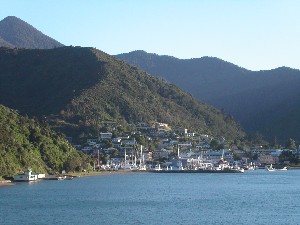 South Island is much more
mountainous than North Island. Here is the ferry terminal in such a setting. How many ferry terminals can boast such spectacular scenery!
South Island is much more
mountainous than North Island. Here is the ferry terminal in such a setting. How many ferry terminals can boast such spectacular scenery!
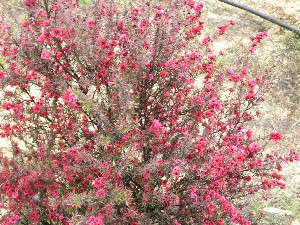 Tea tree grows everywhere in NZ, with hues of dark red through yellow and white. Honey from tea trees is said to have medicinal properties, and it fetches a premium price in the stores.
 We have never seen so many hiking trails and walking tracks as there are in NZ. For the most part, they are well-marked and maintained. Some require considerable strength and even special equipment; most can be walked in sneakers.
 Broom and Gorse, are introduced
species that have run amok, choking out native plants despite Conservation Department efforts. On the other hand, when in bloom, they cover the landscape with beautiful golden yellow blooms.
Broom and Gorse, are introduced
species that have run amok, choking out native plants despite Conservation Department efforts. On the other hand, when in bloom, they cover the landscape with beautiful golden yellow blooms.
 The wine industry in NZ is very advanced, with many wineries having won international awards, especially for their whites. Most of the vineyards, like this one that and Louise-Ann and our son, Kyle, pose in front of are small.